

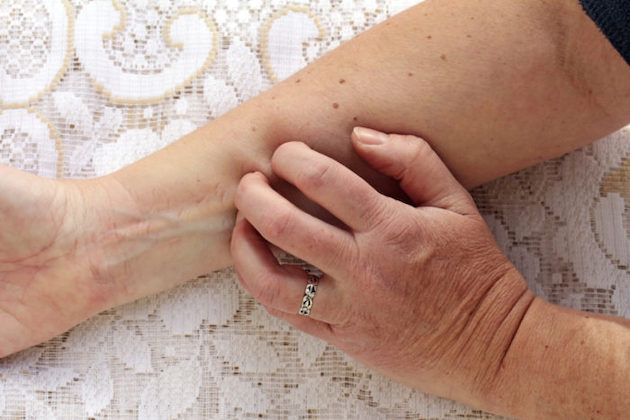
General examination
• Dry skin; pale skin to chronic anaemia.
• Yellow tinge to skin (accumulation of carotenoids, urochromes, and lipochromes) or
diffuse hyperpigmentation (increased melanin).
• Macular purpura: increased vessel fragility, heparin during dialysis.
• Sparse body hair, diffuse alopecia, and/or dry hair.
• Nail changes.
• Signs of scratching.
• Problems associated with AV fistula.
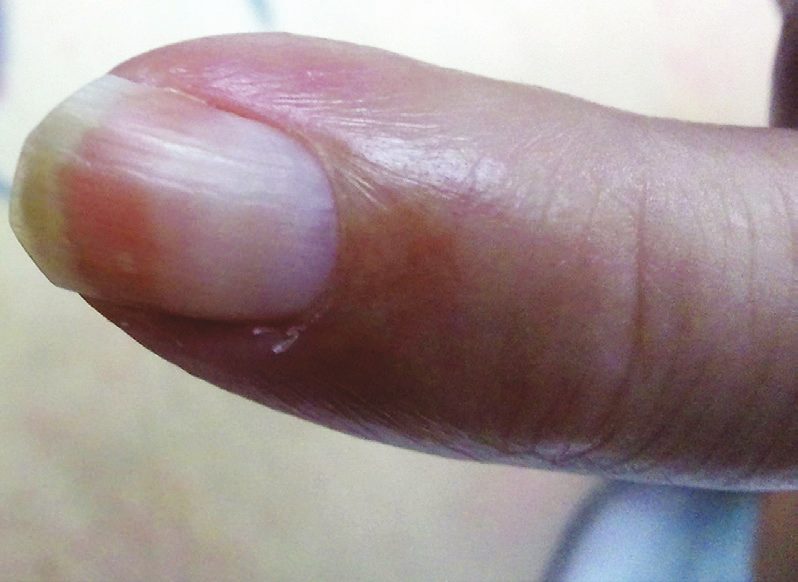
Nail changes
• Transverse white bands (Mees lines): acute kidney injury.
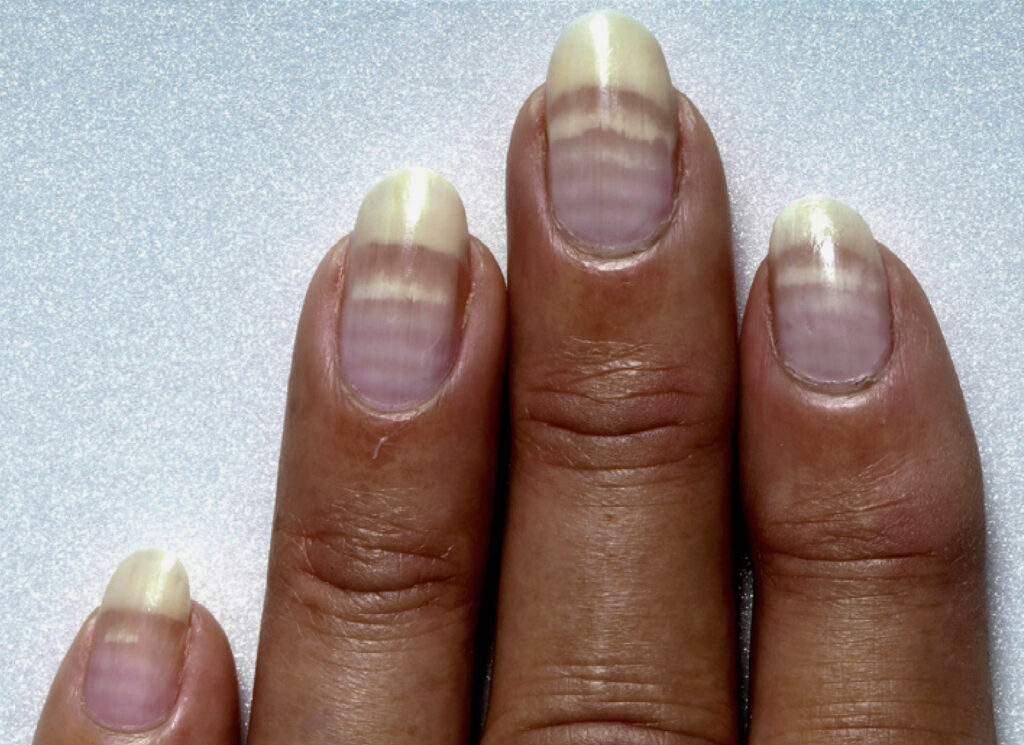
• Paired narrow transverse white lines on several nails (Muehrcke lines):
hypoalbuminaemia in nephrotic syndrome. Bands fade if the nail plate is compressed,
unlike Mees lines.
• ‘Half-and-half’ nails (proximal white, distal brownish-pink = Lindsay nails): uraemia.
• Less frequent changes seen in chronic kidney disease:
o Absence of lunulae.
o Splinter haemorrhages.
o Brittle nails.
o Koilonychia.
Other cutaneous problems
• Cutaneous vasculitis related to underlying problems such as SLE.
• Acquired perforating dermatosis.
• PCT and pseudoporphyria present with skin fragility, erosions, and blisters on exposed
skin, usually the dorsum of the hands. Take a detailed drug history, as many drugs may
be implicated in the pathogenesis of pseudoporphyria.
• Calcific uraemic arteriolopathy (calciphylaxis): a life-threatening condition, seen in
patients on dialysis. Presents acutely with painful mottled erythema that becomes
necrotic.
• Nephrogenic systemic fibrosis; drug reactions.
• Amyloidosis