

- Introduction:
Tofacitinib is an orally administered, small-molecule immunomodulatory agent belonging to the Janus kinase (JAK) inhibitor class. It is used to treat selected inflammatory and autoimmune diseases by modulating intracellular signaling pathways involved in immune responses.
- Current Therapeutic Indications:
Approved indications vary by country, regulatory authority, formulation, and patient age. According to the European Medicines Agency (EMA), the principal indications include the following.2.1. Rheumatoid Arthritis (RA):
– Tofacitinib is indicated for adults with moderately to severely active rheumatoid arthritis who have had an inadequate response to, or are intolerant of, one or more disease-modifying antirheumatic drugs (DMARDs).
– It may be administered in combination with methotrexate or as monotherapy when methotrexate is not tolerated or is inappropriate.2.2. Psoriatic Arthritis (PsA):
Tofacitinib is indicated for adults with active psoriatic arthritis who have had an inadequate response to, or are intolerant of, previous DMARD therapy. Depending on the applicable product label, it may be used in combination with methotrexate.2.3. Ankylosing Spondylitis (AS): Tofacitinib is indicated for adults with active ankylosing spondylitis who have responded inadequately to conventional therapy.
2.4. Ulcerative Colitis (UC):
– Tofacitinib is indicated for adults with moderately to severely active ulcerative colitis who have had an inadequate response, lost response, or been intolerant to conventional therapy or a biologic agent.
– It may be used for induction of clinical response and maintenance of remission according to the approved treatment regimen. The dose and duration should follow the applicable prescribing information.2.5. Juvenile Idiopathic Arthritis (JIA):
– In certain jurisdictions, tofacitinib is approved for children aged 2 years and older with active polyarticular-course juvenile idiopathic arthritis and juvenile psoriatic arthritis who have responded inadequately to previous DMARD therapy.
– The precise indications, eligibility criteria, and appropriate formulations for pediatric patients must be confirmed against the local product label.
- Applications in Dermatology:
Tofacitinib has also been investigated in several dermatologic conditions. However, these applications should be distinguished from formally approved indications.
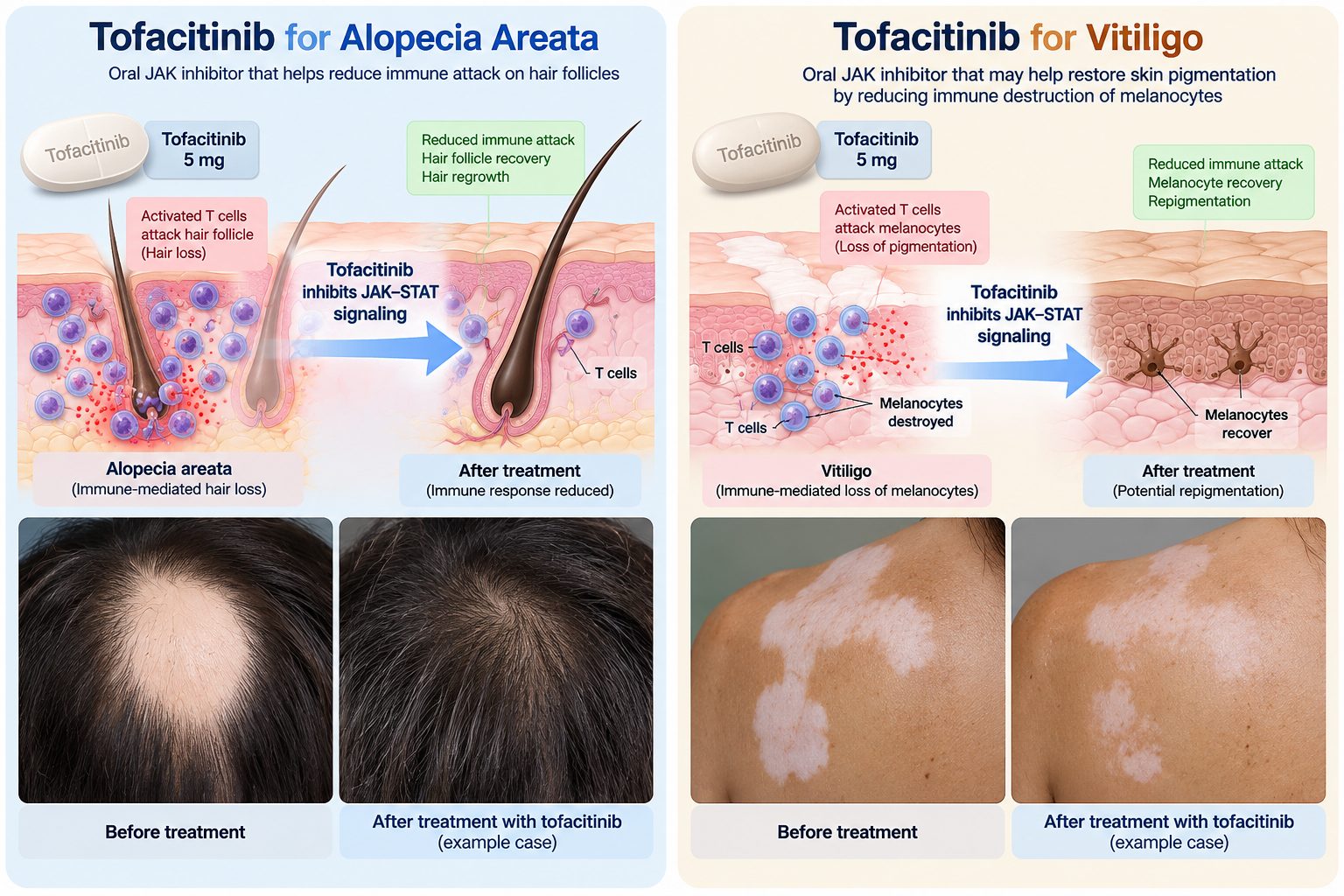
* Alopecia areata: Tofacitinib has been studied because JAK–STAT signaling plays an important role in the pathogenesis of the disease. Nevertheless, tofacitinib is not specifically approved for alopecia areata in many jurisdictions, and its use for this condition is generally considered off-label.
* Vitiligo: Studies have evaluated its potential to promote repigmentation, but evidence regarding efficacy, optimal administration routes, and treatment regimens remains limited.
* Other inflammatory and autoimmune skin disorders: Preliminary studies and case reports have explored potential applications, but the evidence is insufficient to establish these conditions as routine approved indications.
- Pretreatment Assessment and Monitoring:
– Before initiating therapy, clinicians should assess the patient’s infection history, screen for latent tuberculosis, and evaluate viral hepatitis according to applicable guidelines. Baseline investigations generally include a complete blood count, liver and renal function tests, and a lipid profile.
– Vaccination status should be reviewed, and live vaccines should generally be avoided during treatment in accordance with the applicable prescribing information.
– During therapy, patients should be monitored for signs of infection, hematologic abnormalities, liver enzyme elevations, and lipid changes. Monitoring frequency should be tailored to the product label, comorbidities, and clinical circumstances. Treatment interruption or discontinuation may be necessary if a serious infection or clinically significant laboratory abnormality develops.
- Conclusion:
– Tofacitinib is an oral JAK inhibitor with an established role in the treatment of selected inflammatory and autoimmune diseases, including rheumatoid arthritis, psoriatic arthritis, ankylosing spondylitis, ulcerative colitis, and certain forms of juvenile arthritis, depending on local regulatory approval.
– Although its oral administration and modulation of multiple cytokine signaling pathways offer important therapeutic advantages, treatment carries clinically significant risks, particularly serious infections, cardiovascular events, thrombosis, and malignancy.
– Its use should therefore be guided by an appropriate indication, individualized benefit–risk assessment, and careful clinical and laboratory monitoring.